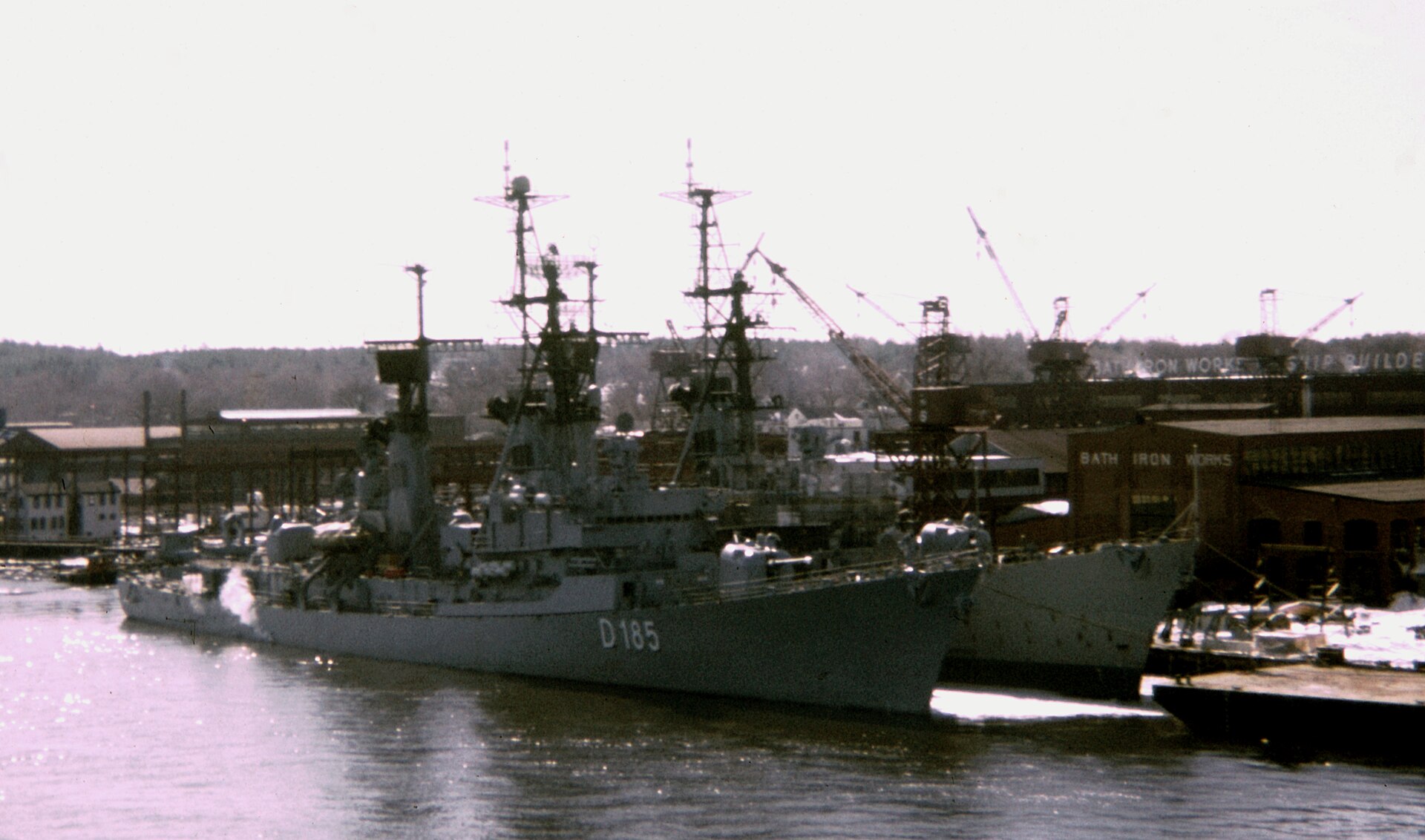
Bath Iron Works and Navy Asbestos Exposure
Bath Iron Works (BIW) has operated on the Kennebec River in Bath, Maine since 1884. For generations of Maine tradesmen — pipe laggers, boilermakers, pipefitters, electricians, welders, and painters — BIW meant steady work building warships. It also allegedly meant decades of unprotected asbestos exposure.
Many of those workers now carry diagnoses of mesothelioma, asbestosis, or asbestos-related lung cancer. These diseases arrive forty years after the exposure that caused them. If you or a family member worked at BIW and received one of these diagnoses, strict time limits govern your right to file a claim. Act without delay.
What BIW Built and Where Asbestos Was Used
Naval Construction at Bath Iron Works
BIW has held major U.S. Navy contracts throughout the twentieth and twenty-first centuries, constructing:
- Destroyers throughout World War II and beyond
- Guided-missile frigates (FF/FFG class)
- Arleigh Burke–class (DDG-51) destroyers
- Cruisers and other surface combatants
The yard encompasses dry docks, fabrication shops, outfitting piers, and enclosed machinery spaces. All of these environments allegedly accumulated asbestos dust at dangerous concentrations during peak construction and overhaul periods from roughly the 1930s through the early 1980s.
Why the Navy Mandated Asbestos
Bureau of Ships specifications allegedly mandated or strongly encouraged asbestos insulation on virtually every steam system aboard combat vessels. Asbestos was heat-resistant, durable, and cheap. Those properties made it standard across every surface warship class BIW built.
Specific ACMs Installed at Bath Iron Works
Workers at BIW are alleged to have been exposed to asbestos-containing materials (ACMs) throughout the ships under construction:
- Pipe covering and block insulation — Kaylo (Owens-Illinois), Thermobestos, and Aircell (Johns-Manville, Armstrong World Industries) on steam lines, feedwater systems, and engineering spaces
- Boiler insulation and refractory brick — refractory systems allegedly supplied by Combustion Engineering and Babcock & Wilcox for propulsion boilers and high-temperature systems
- Gaskets and packing — asbestos-containing gaskets and valve packing from Crane Co., Garlock Sealing Technologies, and Eagle-Picher throughout flanged joints and valve assemblies
- Spray-applied fireproofing — Monokote and Zonolite (W.R. Grace) on structural steel, bulkheads, and machinery spaces
- Insulation board and building materials — transite board and deck tile from Gold Bond, Pabco, and Celotex in insulated compartments and accommodation spaces
- Electrical insulation — asbestos-containing wrapping, conduit, and panel components across multiple manufacturers’ product lines
Why Ship Compartments Were Particularly Dangerous
These materials were installed in confined ship compartments with minimal ventilation. Fiber concentrations are alleged to have reached levels far exceeding what OSHA would later permit. Workers operated in spaces where asbestos dust accumulated without air circulation, respiratory protection, or hazard warnings.
Who Faced the Highest Exposure at BIW
Pipe Laggers and Heat Insulators
Laggers worked directly with raw Kaylo pipe covering, Thermobestos blocks, and Aircell insulation — cutting sections to fit, shaping them around hot steam lines, and applying them throughout ship compartments. Their work allegedly generated clouds of asbestos dust in enclosed spaces continuously throughout construction and overhaul operations.
Pipefitters and Steamfitters
Pipefitters cut through existing insulation to access flanges and valves — a process that released substantial fiber concentrations even when laggers were not present. These workers disturbed already-installed ACMs during routine maintenance and connection work aboard every class of vessel BIW built.
Boilermakers
Boilermakers installed, maintained, and repaired propulsion boilers insulated with refractory brick, block insulation from Johns-Manville and Combustion Engineering, and asbestos packing materials. They are alleged to have experienced some of the highest fiber counts in the yard.
Electricians
Electricians ran wiring through insulated spaces and reportedly disturbed transite board, W.R. Grace spray fireproofing, and asbestos-wrapped conduit as part of routine installation and modification work.
Welders and Burners
Welders and cutting-torch operators worked near Kaylo-insulated piping and Monokote-coated steel in compartments where asbestos insulation was already installed. Through most of BIW’s peak construction era, no protective measures were reportedly in place.
Painters
Painters preparing surfaces in engine rooms and machinery spaces worked in environments contaminated with asbestos debris from adjacent trades, inhaling fibers re-suspended by air movement and ongoing work activity.
Laborers and Helpers
Laborers swept asbestos debris — fragments of Kaylo, Monokote, and Gold Bond transite — from confined ship compartments using dry brooms. Each sweep allegedly re-suspended settled fibers directly into breathing zones. Many carried contaminated clothing home without decontamination, placing family members at secondary exposure risk.
When Exposure Was Greatest
New Construction vs. Overhaul
Exposure during new destroyer and frigate construction was reportedly substantial, with fresh Kaylo pipe covering, Johns-Manville block insulation, Monokote spray fireproofing, Crane Co. gaskets, and Combustion Engineering boiler systems being installed throughout each vessel from keel to superstructure.
Overhaul and repair work generated the highest fiber concentrations. When older ships returned to BIW for refit, workers removed deteriorated, friable ACMs — aged Thermobestos, Aircell, and Kaylo products — before new systems could go in. Removal of friable, aged insulation releases exponentially more airborne fiber than original installation.
Peak Exposure Periods
- World War II (1941–1945) — massive destroyer production, minimal safety controls, widespread installation of Johns-Manville, Owens-Illinois, and Armstrong Cork products
- Cold War frigate program (1970s–early 1980s) — sustained FF/FFG and DDG-51 construction with continued reliance on Kaylo, Monokote, and comparable ACMs
- Routine overhaul and maintenance — continuing through the 1980s and beyond, involving removal and replacement of deteriorated insulation systems
What Regulators Knew and When
EPA NESHAP
EPA NESHAP regulations (40 C.F.R. Part 61, Subpart M) require notification and controlled removal when ACMs are disturbed during demolition or renovation. These requirements reflected regulatory awareness, by the 1980s, that manufacturers including Johns-Manville, W.R. Grace, and Owens-Illinois had known of asbestos hazards far earlier and failed to warn the workers using their products.
OSHA Standards
OSHA first promulgated asbestos standards in 1971 and strengthened them in 1986, establishing permissible exposure limits, engineering controls, mandatory respiratory protection programs, and worker training requirements.
Protection Gaps at Bath Iron Works
Public records and litigation documents suggest protective measures at BIW were reportedly inadequate or inconsistently applied through much of the 1960s and 1970s. Former employees have alleged in litigation that:
- Manufacturers did not provide hazard warnings despite internal knowledge of asbestos risks
- Appropriate respirators were not furnished during Kaylo, Thermobestos, and Monokote removal operations
- Work practices did not comply with standards OSHA later established
Workers seeking OSHA inspection records relating to BIW may submit requests through OSHA’s public records process.
Diseases That Follow Asbestos Exposure at Shipyards
Latency: Why Diagnoses Are Arriving Now
Inhaled asbestos fibers lodge permanently in lung tissue and the pleural lining. The inflammatory process they trigger may not produce a diagnosable disease for twenty to fifty years. Workers exposed to Johns-Manville products, Kaylo, Monokote, and Crane Co. gaskets at BIW during the 1950s through the early 1980s are receiving mesothelioma diagnoses today.
Malignant Mesothelioma
VA evaluates asbestos claims individually. Veterans generally need evidence of in-service asbestos exposure, a current diagnosis, and a medical nexus between them.
Asbestosis
Asbestosis is progressive scarring of lung tissue from chronic fiber inhalation. The condition produces disabling breathlessness with no cure. Workers may pursue claims through civil litigation, asbestos bankruptcy trusts, and the Longshore and Harbor Workers’ Compensation Act.
Asbestos-Related Lung Cancer
Asbestos exposure dramatically multiplies lung cancer risk, particularly for workers who also smoked. Asbestos-related lung cancer is frequently misdiagnosed as primary lung cancer in the absence of a documented occupational history. Establishing a claim requires proof of exposure to specific manufacturers’ ACMs.
Families of Deceased Workers
Because of the twenty-to-fifty-year latency period, new cases continue to be filed each year. Families of workers who have died from mesothelioma, asbestosis, or asbestos-related lung cancer may pursue wrongful death claims. Wrongful death deadlines are as strict as those governing personal injury claims — contact a maritime asbestos attorney immediately.
Three Legal pathways
Former BIW workers and their families have multiple legal avenues available. Each carries different deadlines, different defendants, and different potential recovery amounts.
Path 1: Federal Maritime Civil Lawsuit Against Product Manufacturers
The Three-Year Federal Maritime Statute of Limitations
The federal maritime statute of limitations is three years from the date of diagnosis under 46 U.S.C. § 30106. This deadline is strictly enforced. Do not delay.
Who You Sue
Claims target the manufacturers and suppliers of the specific ACMs to which a worker was exposed — not necessarily BIW itself. Defendants in BIW-related asbestos litigation have included:
- Johns-Manville (now the Manville Personal Injury Settlement Trust) — Thermobestos block insulation, Aircell pipe covering, and other insulation products
- Owens-Illinois — Kaylo pipe covering and block insulation
- W.R. Grace — Monokote spray fireproofing and Zonolite products
- Combustion Engineering — boiler insulation systems
- Babcock & Wilcox — boiler components and refractory systems
- Armstrong World Industries — pipe covering and building insulation products
- Crane Co. — asbestos-containing gaskets and valve packing
- Garlock Sealing Technologies — gaskets and packing
- Eagle-Picher Industries — industrial gaskets and insulation products
What You Must Prove
To recover in a maritime asbestos case, a claimant must establish:
- Product identification — the specific ACMs to which you were exposed, by manufacturer
- Causation — that exposure to those products was a substantial contributing cause of your disease
- Damages — medical costs, lost income, pain and suffering, and related losses
Maritime courts handling these cases include the Eastern District of Virginia, the Southern District of Texas, and the Western District of Washington, among others. An experienced maritime asbestos attorney will identify the appropriate venue and defendants for your specific work history.
Path 2: Asbestos Bankruptcy Trust Claims
Dozens of asbestos product manufacturers — including Johns-Manville, Owens Corning, Eagle-Picher, and W.R. Grace — filed for bankruptcy protection and established trust funds as a condition of reorganization. These trusts collectively hold billions of dollars reserved specifically for asbestos claimants.
Trust claims operate independently of civil litigation. You may file trust claims and pursue a civil lawsuit simultaneously — these are not mutually exclusive remedies. Trust claims do not require filing suit in court and are governed by each trust’s own claim forms, exposure criteria, and payment schedules.
Key point: Trust claims are available regardless of when the shipyard operated or closed. The trusts exist precisely because the companies
For informational purposes only. Not legal advice. No attorney-client relationship is created by reading this page. © 2026 Rights Watch Media Group LLC — Disclaimer · Privacy · Terms · Copyright
Recent News & Developments
Bath Iron Works (BIW) remains an active major naval shipbuilding facility, continuing to construct Arleigh Burke-class destroyers and other Navy vessels. In May 2025, the Portland Press Herald reported that Bath Iron Works laid the keel for its newest Navy destroyer, underscoring the shipyard’s ongoing central role in American naval construction. Secretary of Defense Pete Hegseth was also reported as planning a visit to the facility in early 2026, reflecting BIW’s continued prominence in national defense policy discussions.
For veterans and former civilian workers, these operational developments serve as a reminder that asbestos exposure at BIW spanned decades of destroyer and frigate construction, particularly from the 1940s through the 1980s, when asbestos-containing insulation, pipe lagging, gaskets, and deck materials were standard throughout the shipbuilding process.
VA evaluates asbestos claims individually. Veterans generally need evidence of in-service asbestos exposure, a current diagnosis, and a medical nexus between them.
Litigation and Trust Funds: Numerous asbestos product manufacturers whose materials were used extensively at BIW — including suppliers of insulation, boiler components, and pipe fittings — have established bankruptcy trust funds. These trusts, including those created by former insulators and equipment manufacturers, continue to process claims from shipyard workers and their families. Payment tier adjustments within individual trusts occur periodically and can affect every available legal claim.
Environmental and Regulatory Landscape: OSHA’s permissible exposure limit for asbestos remains enforceable at active shipyard operations, and any ongoing abatement or renovation work at BIW facilities is subject to NESHAP regulations under the Clean Air Act. Workers involved in current demolition or renovation projects at older BIW structures should monitor EPA and Maine DEP notifications for asbestos abatement disclosures.
The WWII-era workers honored by the Congressional Gold Medal Act, as reported by the Portland Press Herald in November 2020, reflect the long history of labor at this facility — and the generations of workers who faced asbestos exposure without adequate warning or protection.
Civilian and military workers at this shipyard who were diagnosed with mesothelioma, lung cancer, or asbestosis may have legal rights under federal maritime law and applicable state statutes. Multiple asbestos trust funds hold assets specifically for shipyard workers and their families.