USS Caloosahatchee (AO-98) was a Cimarron-class fleet oiler, built during the Second World War but commissioned after the war ended, and in Navy service from 1945 to 1990. Steam-powered ships of her construction era are documented in public litigation records as carrying asbestos thermal insulation, gaskets, and packing throughout their machinery spaces. We hold no ship-specific documentation of the materials aboard AO-98.
This page is a public-records reference, and it is deliberately incomplete. The Navy’s own published history of this ship covers her construction and her first fifteen years, then stops until her decommissioning — it says nothing about the conversion, deployments, or overhauls between 1960 and 1990. Where we have no source we have read, we say so rather than fill the gap.
Documented Service Record
From the Navy’s Dictionary of American Naval Fighting Ships entry for this hull:
- Launched 2 June 1945 by Bethlehem-Sparrows Point Shipyard, Inc., Sparrows Point, Maryland, under a Maritime Commission contract
- Acquired and commissioned 10 October 1945, Commander H. R. Livingston, USNR, in command; reported to Commander, Service Force, Atlantic Fleet
- Decommissioned 28 February 1990; stricken from the Naval Vessel Register 18 July 1994
- Final disposition — moored with the James River Reserve Fleet until 18 October 2003, when she was taken under tow for scrapping at the Able UK facility, Teesside, England
Her keel is reported as laid 30 November 1944, but that date appears only in secondary references and is not confirmed by the Navy’s own entry. DANFS gives her as-built figures as 7,295 displacement, 553 feet in length, 75-foot beam, 18 knots, complement 304. Other published references give different displacement and complement figures, and her post-conversion dimensions are reported inconsistently across sources — we have not resolved those conflicts and do not publish them. If you have her characteristics from a source you hold, we would like to see it.
A note on the class name: this hull belongs to the World War II Cimarron class begun in 1939. A later, unrelated class of fleet oilers built in the 1980s reuses the same class name. They are different ships, and facts about the later class do not describe AO-98. Some published references give the Cimarron class range as AO-22 through AO-57, a range that would exclude this hull; DANFS assigns AO-98 to the Cimarron class, and we follow DANFS.
The 1966–1969 Key Highway Yard Period
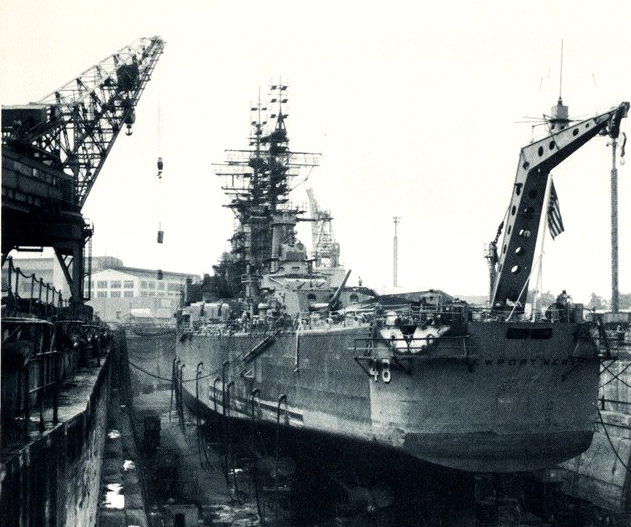
The single most significant documented asbestos-disturbance window for this hull is her conversion, carried out at Bethlehem Steel’s Key Highway Shipyard in Baltimore, Maryland. It is described in published references, though not confirmed by the Navy’s own history, as a “jumboization” — a new midbody built and welded in between her original bow and stern.
A memorandum in a publicly filed U.S. District Court asbestos case in Maryland records the yard period for this hull directly: “The AO 98 was at the Shipyard from August 1966 through September 1969.” Sources differ on when the conversion work itself began — the court record’s August 1966, against a veterans’ association history placing her return to Key Highway in May 1968 — and we have not resolved that. What is consistent across the sources is a multi-year yard period ending with her departure from the yard in September 1969.
Testimony recited in that same court record describes a welder working aboard AO-98 on pipelines, boilers, and heating coils, in the boiler room and in the vicinity of contractor insulators removing and installing insulation on the boilers and pipelines. Insulation tear-out and re-installation around a ship’s steam plant is the work that puts fiber into the air of a closed engineering space, and it reaches everyone working in that space — not only the men handling the lagging.
All of the above reflects what has been alleged and documented in publicly filed records, pending testimony. It is not a finding of fact or of liability against anyone. In that case the court granted summary judgment to the boiler manufacturer — on the ground that the plaintiffs could not identify who supplied the insulation that created the dust — and to other defendants on related causation grounds.
Class-typical engineering plant — from a sister ship’s records, not AO-98’s own
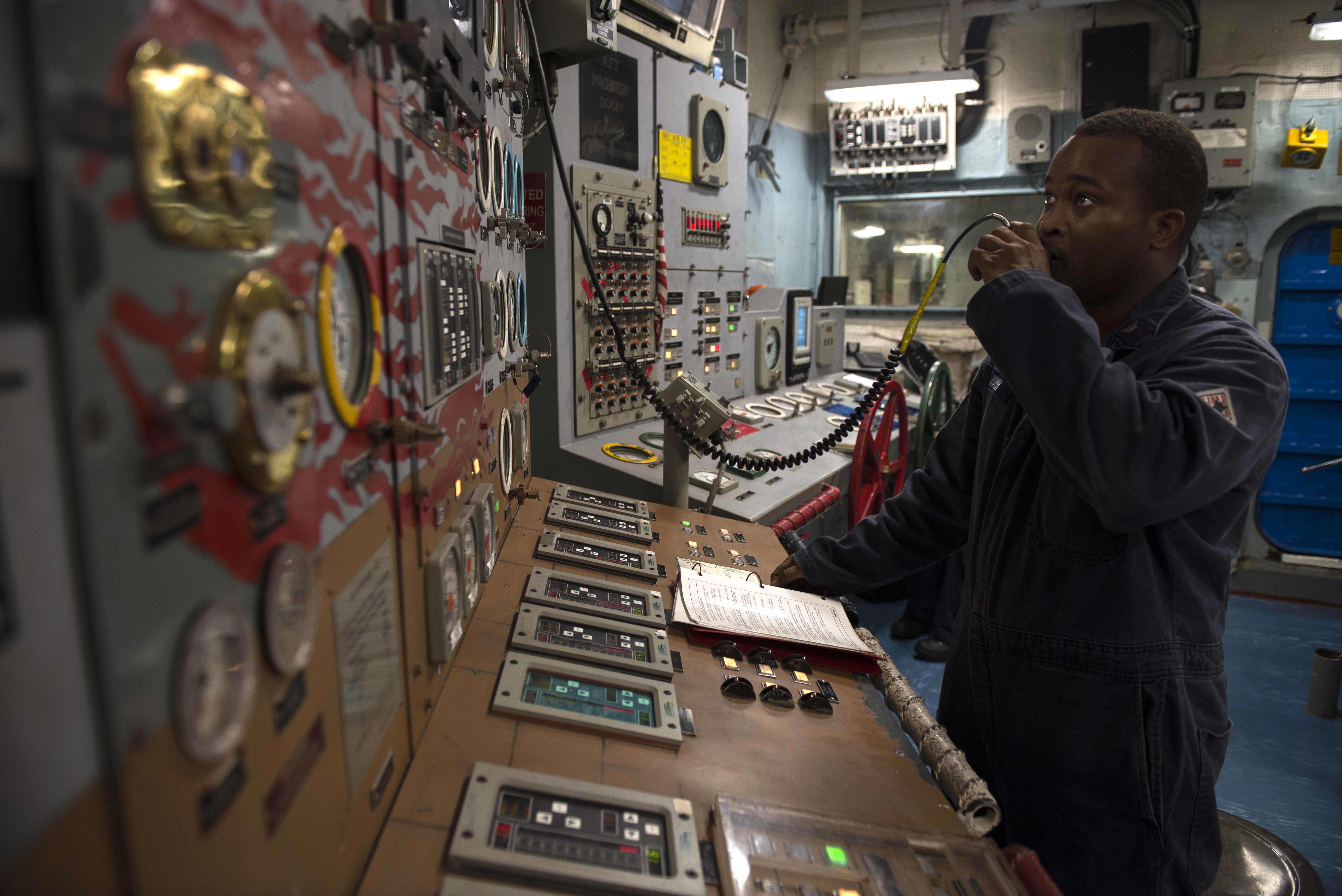
We hold no machinery record for this hull. The layout below is drawn from a sister oiler’s BUSHIPS manifest and from the general configuration of steam oilers of this generation. It describes the type, not this ship:
- Firerooms — boiler block insulation, refractory, and lagged uptakes; boiler tear-down and re-bricking during yard periods
- Engine rooms — main propulsion turbines, reduction gears, and ship-service turbo-generators under removable insulation blankets that were unwired and re-wired at every overhaul
- Pump rooms and cargo-pump spaces — an oiler’s defining machinery; cargo oil, stripping, and gasoline pumps with asbestos gaskets and braided packing replaced by hand
- Lagged steam, feed, fuel-oil, and condensate piping running the length of the ship, including through berthing and passageways well outside the machinery spaces
- Distilling plants, heat exchangers, and valves, whose flange gaskets and gland packing were cut, scraped, and renewed as routine maintenance
How little class data settles is worth stating: the sister-ship manifest we consulted lists both Babcock & Wilcox and Foster Wheeler boilers, so it cannot even resolve which boiler maker was aboard a given hull.
Ratings that worked in and around these systems aboard ships of this type included Boilerman/Boiler Tender, Machinist’s Mate, Electrician’s Mate, Hull Maintenance Technician, and Damage Controlman. Per public litigation records, machinery of this type and its associated insulation, gaskets, and packing allegedly contained asbestos.
One manufacturer attribution is specific to this hull, and it is narrow: in answers to interrogatories recited by the court, Foster Wheeler stated that in 1944 it held contracts to supply marine type “D” boilers for the construction of AO-98 and AO-99. That is one component and one maker, resting on a manufacturer’s own admission. One other maker, General Electric, appears in the public record only as an allegation that it supplied equipment for this vessel. Beyond those two we can name no manufacturer for this hull, and we will not infer one from a sister ship — the jumboized sisters were converted in different yards.
Her Equipment Record Is Missing — Help Us Build It
No ship-specific BUSHIPS equipment manifest has been published for USS Caloosahatchee (AO-98) in our records. For many hulls we publish a full machinery-and-manufacturer table naming what was installed aboard. For this one we cannot, because we do not hold the document, and we will not populate a table by guessing.
That gap is exactly what her crew can close. If you served aboard her — in a fireroom or engine room, in the pump rooms, on deck during UNREP, or in the yard at Baltimore during the conversion — you know things no archive on our shelf records:
- Which boilers, turbines, pumps, and evaporators were actually in your spaces, and whose nameplates were on them
- What the yard was doing to the lagging during the 1966–1969 conversion, and where the crew was berthed while it happened
- Overhauls, RAVs, and availabilities after 1969, which the Navy’s published history does not cover at all
- Anything above that is wrong — a date, a figure, a name
Use the account form on this page. Accounts are personal recollections, not archival records; they sit alongside the documented record and are reviewed before they appear. You can also browse our catalogue of ship equipment manifests to see the kind of record we are trying to assemble for this hull.
Service details are drawn from the Navy’s published Dictionary of American Naval Fighting Ships entry for this vessel. The yard period, the boiler-contract attribution, and the insulation testimony are drawn from a publicly filed U.S. District Court asbestos proceeding and reflect what has been documented or alleged in those records; no individual is named here, and nothing on this page is a finding of fact or liability. Conversion-era details not confirmed by a source we have read are marked as unconfirmed or omitted. Published by an independent publisher; this is not legal or medical advice.
The asbestos-containing products documented on U.S. Navy vessels and at shipyards are catalogued by manufacturer on AsbestosIndex. These records cross-reference which companies supplied which materials and to which facilities.
Navy Ratings Most Exposed to Asbestos Aboard Caloosahatchee
The U.S. Department of Veterans Affairs and the public asbestos litigation record document that the following Navy ratings worked routinely in spaces where ACM was installed, maintained, ripped out, and replaced:
VA Disability Claims for Asbestos-Related Disease
The U.S. Department of Veterans Affairs evaluates asbestos claims individually. A veteran generally needs medical evidence of a current asbestos-related disease, service evidence supporting in-service asbestos exposure, and a medical opinion connecting the two. Ship assignments, Navy ratings, and equipment records can help document the exposure history but do not create automatic service connection.
Approved claims may provide monthly disability compensation and related benefits. Survivors may separately qualify for Dependency & Indemnity Compensation when the applicable requirements are met. Civil lawsuits and asbestos-trust claims use different standards; claimants should obtain individualized advice about how the processes interact.
How to file a VA disability claim: VA claims are filed directly with the U.S. Department of Veterans Affairs — not with a law firm. Start at VA.gov › Hazardous Materials Exposure, call 1‑800‑827‑1000, or get free help filing from a Veterans Service Organization: DAV, VFW, or American Legion.
VA Claims Guide on This Site › Compare: VA vs. Civil Lawsuit
Source notes: equipment-manifest entries (where shown) are sourced from public-record BUSHIPS (Bureau of Ships) documentation, NARA archives, and the public asbestos litigation record. Manufacturer attributions link to documented asbestos-product histories on AsbestosIndex.com where available. Nothing on this page constitutes medical or legal advice.