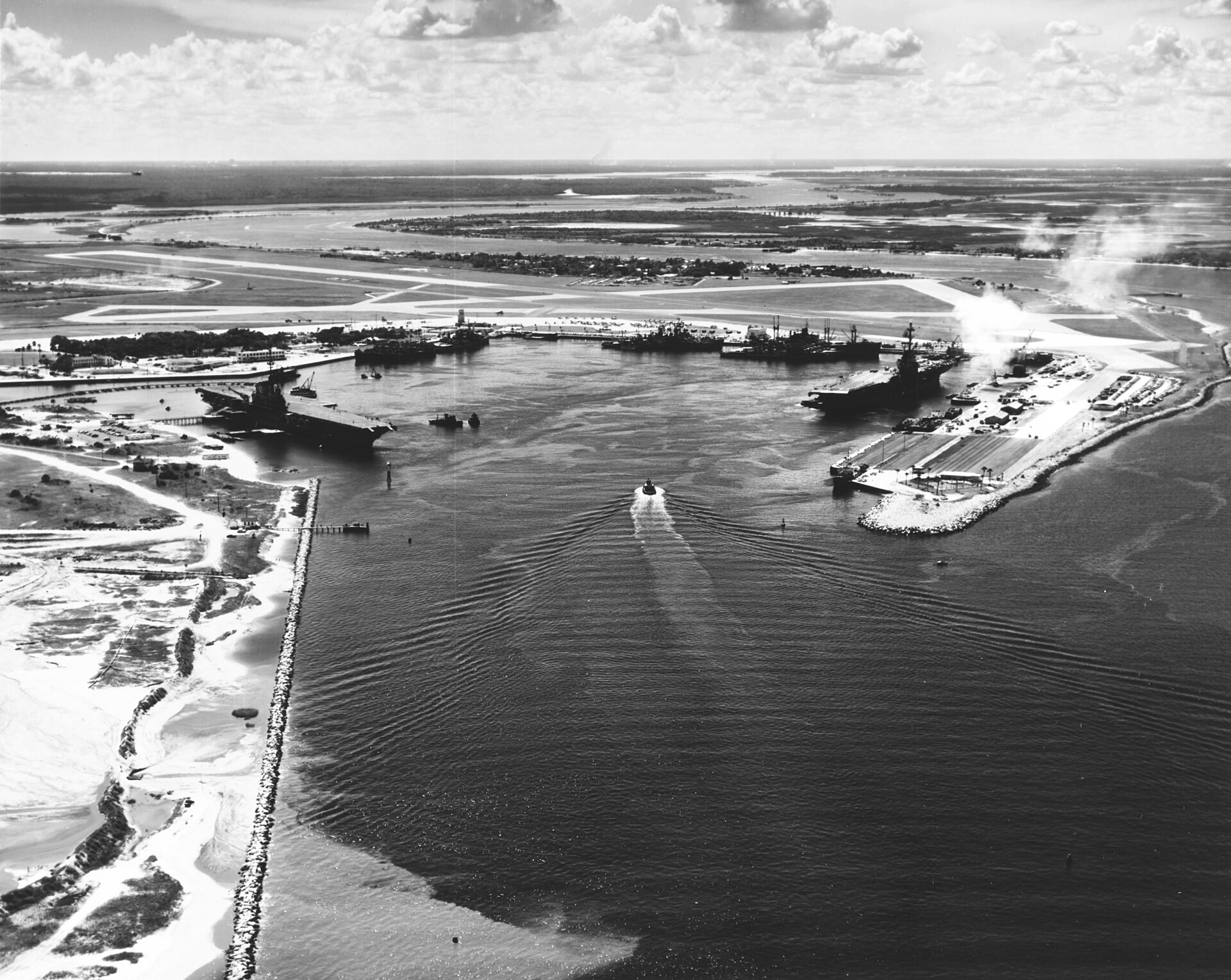
If you served at Naval Station Mayport and have been diagnosed with mesothelioma, asbestosis, or lung cancer, your disease may be connected to asbestos exposure during your military service or civilian employment at the base. Asbestos-related illnesses typically do not appear until 20 to 50 years after exposure — which means veterans and workers assigned to Mayport during the 1950s, 1960s, and 1970s are receiving diagnoses today. Federal law provides VA disability benefits with no filing deadline and civil lawsuit options with a three-year statute of limitations running from your diagnosis date. Contact an experienced Navy asbestos exposure attorney immediately — delay forfeits compensation your family is owed.
What Is Naval Station Mayport?
Location and Strategic Role
Naval Station Mayport sits in Duval County, Florida, along the St. Johns River approximately 20 miles east of Jacksonville. Commissioned in 1942, Mayport became the third-largest naval fleet concentration area on the East Coast and one of the Atlantic Fleet’s primary homeports — a major berthing and maintenance hub alongside Norfolk, San Diego, and Charleston.
Facilities and Operations
The base has historically homeported destroyers, frigates, cruisers, and amphibious assault ships, with naval aviation squadrons operating from the on-base airfield. Mayport operates as a full-service naval installation with:
- Ship repair facilities and drydocks
- Aircraft maintenance hangars
- Shore-side support infrastructure
- Boiler plants and mechanical systems
- Steam tunnel networks serving base-wide heating
Asbestos Use in Navy Base Construction
Why the Navy Used Asbestos-Containing Materials
From the 1930s through the mid-1970s, asbestos-containing materials (ACMs) were the construction standard across virtually every category of military facility in the United States. The Navy, Army Corps of Engineers, and civilian federal construction contractors relied on asbestos products manufactured by Johns-Manville, Owens Corning, Eagle-Picher, W.R. Grace, Georgia-Pacific, Celotex, Armstrong World Industries, and Crane Co. for their documented fire-resistance properties, thermal insulation performance, low cost, and compatibility with military construction specifications and federal procurement contracts.
Facility Types Built With Asbestos
Shore installations like Naval Station Mayport were built to the same construction standards applied to Navy vessels — standards that incorporated asbestos across mechanical, structural, and building materials. Facility types with documented ACM presence include:
- Boiler plants and steam distribution systems
- Aircraft maintenance hangars
- Ship repair facilities and drydocks
- Machine shops and pipe shops
- Barracks buildings
- Base housing units
- Administrative structures
- Steam tunnel networks
Asbestos-Containing Materials at Naval Station Mayport
Documented ACM Products and Locations
Public litigation records and EPA NESHAP notification filings associated with military facility renovation and demolition projects indicate that Naval Station Mayport facilities reportedly contained asbestos-containing materials across multiple building systems and components.
Steam and Heating Systems
- Asbestos lagging and block insulation on hot-water and steam piping throughout base distribution networks — reportedly Johns-Manville products including Kaylo brand block insulation and Thermobestos pipe wrap
- Owens Corning and Owens-Illinois asbestos block insulation on boiler casings
- Asbestos valve packings and gasket materials manufactured by Garlock Sealing Technologies and Crane Co.
- High-temperature pipe insulation on pressurized lines, including Eagle-Picher Superex products
Boiler Plants
- Asbestos block insulation on boiler casing and exterior surfaces — allegedly Johns-Manville Kaylo and W.R. Grace products, documented in EPA NESHAP abatement records for Naval facility remediation
- Asbestos-containing gaskets and packing materials manufactured by Garlock Sealing Technologies
- Insulation on adjacent high-temperature pipe runs, including products from Combustion Engineering
Aircraft Maintenance Hangars
- Spray-on asbestos fireproofing applied to structural steel — reportedly Monokote brand spray fireproofing manufactured by W.R. Grace and competitive products by Armstrong World Industries
- Asbestos-containing transite board used for wall and partition panels — documented products manufactured by Johns-Manville and Georgia-Pacific
- Asbestos floor tiles (VAT) in workshop areas — allegedly Armstrong World Industries Gold Bond and Celotex branded products per asbestos trust fund claim data
Barracks and Base Housing
- Asbestos floor tiles (VAT) throughout living spaces — reportedly Pabco, Armstrong Gold Bond, and Sheetrock brand products manufactured by Georgia-Pacific
- Asbestos-containing ceiling tiles — allegedly Armstrong World Industries and Owens Corning products
- Pipe insulation in utility chases and mechanical spaces — reportedly Johns-Manville Unibestos, Kaylo, and Thermobestos products
Ship Repair Facilities and Drydocks
- Asbestos pipe insulation and lagging — documented products including Johns-Manville brand materials and W.R. Grace Aircell insulation
- Asbestos gasket and packing materials regularly handled during maintenance — manufactured by Garlock Sealing Technologies and Crane Co. Cranite products
- Asbestos-containing materials in adjacent support shops — including Celotex board products and Georgia-Pacific transite materials
Who Was Exposed to Asbestos at Mayport
Active-Duty Service Members
Active-duty sailors assigned to Naval Station Mayport encountered asbestos exposure through:
- Berthing in barracks constructed with asbestos floor and ceiling tiles — reportedly Armstrong, Pabco, and Georgia-Pacific branded materials
- Assignment to shore-based engineering support and maintenance commands
- Routine operations in facilities containing disturbed ACMs
- Renovation and repair work on aging base infrastructure
Marine Corps personnel billeted in base barracks reportedly faced similar exposure conditions.
Civilian DoD Employees and Contract Workers
Civilian Department of Defense employees and contract workers at Mayport carried elevated exposure risk based on their trades and job duties.
Pipefitters and plumbers cut, removed, and replaced asbestos pipe insulation manufactured by Johns-Manville, W.R. Grace, and Owens Corning as routine work on base steam systems. Direct, friable ACM contact was a daily occupational reality.
Boilermakers performed maintenance on boiler plants, disturbing asbestos block insulation manufactured by Johns-Manville Kaylo, W.R. Grace, and Crane Co. during inspections, tube replacements, and overhauls.
Insulators applied or removed thermal insulation with direct ACM contact — including Johns-Manville pipe wrap products, W.R. Grace Aircell materials, and Eagle-Picher products.
Electricians worked in mechanical spaces, steam tunnels, and boiler rooms where asbestos lagging manufactured by Johns-Manville and Owens Corning was present on adjacent pipe runs — bystander exposure with no less serious consequences.
HVAC technicians encountered asbestos-containing duct insulation and equipment seals — reportedly Armstrong and Georgia-Pacific products — while maintaining base heating systems.
Additional exposed occupations:
- Mechanical engineers and supervisors conducting maintenance inspections of asbestos-insulated systems
- Carpenters and construction workers disturbing Johns-Manville transite board, Georgia-Pacific partitions, and asbestos-laden structural materials during facility renovations
- General laborers assisting in system overhauls and repairs
Peak Exposure Periods at Naval Station Mayport
World War II Era (1942–1945)
Foundational facility construction used the most heavily asbestos-laden materials of any period — reportedly Johns-Manville, Owens Corning, and W.R. Grace products. Workers installed pipe insulation, boiler block materials including Kaylo and Thermobestos, and structural fireproofing throughout the base.
Korean War Expansion (1950–1955)
Additional permanent structures were built to identical specifications. Increased ship homeporting expanded the base footprint and ACM volume. Garlock, Armstrong, and Celotex asbestos products were installed across facility expansions.
Vietnam War Operations (1965–1973)
Ship traffic and facility utilization increased substantially. ACMs installed decades earlier began deteriorating and becoming friable. Maintenance and repair of systems containing Johns-Manville, W.R. Grace, and Georgia-Pacific asbestos materials generated airborne fiber release during routine work — exposure that was largely uncontrolled and unwarned.
Late 1970s–1980s Renovation Period
Navy efforts to address aging infrastructure created secondary exposure as workers disturbed intact but deteriorating asbestos materials without adequate abatement controls. Civilian contractors removing Pabco, Gold Bond, and Sheetrock floor coverings and Johns-Manville transite partitions faced direct fiber contact during demolition work.
Asbestos-Related Diseases: Diagnosis and Latency
The Latency Period
Asbestos-related diseases typically do not appear until 20 to 50 years after initial exposure. This explains why veterans and civilian workers who served at Naval Station Mayport in the 1950s, 1960s, and 1970s are receiving diagnoses today — often decades into retirement.
Diseases Caused by Asbestos Exposure
Mesothelioma Malignant cancer of the pleural lining of the lungs or the peritoneal lining of the abdomen. Caused almost exclusively by asbestos exposure. Average survival after diagnosis: 12 to 21 months without aggressive treatment intervention.
Asbestosis Progressive, irreversible scarring of lung tissue that impairs breathing and oxygen absorption over time. Advanced stages frequently require continuous oxygen support.
Asbestos-Related Lung Cancer Develops decades after initial exposure. Risk increases substantially in individuals with any smoking history — but smoking does not eliminate an asbestos exposure claim.
Other Asbestos-Related Conditions
- Pleural plaques and pleural thickening
- Pleural effusions
- Laryngeal cancer
- Ovarian cancer, increasingly recognized in the medical and legal literature
What This Means for Mayport Veterans and Workers
A current diagnosis of mesothelioma, asbestosis, lung cancer, or pleural disease in anyone with documented Naval Station Mayport service or employment warrants immediate legal and VA consultation. The three-year civil statute of limitations under 46 U.S.C. § 30106 begins on the diagnosis date — not when symptoms first appeared, and not when you first suspected asbestos. Delay forfeits compensation that cannot be recovered.
VA Presumptive Disability Benefits for Veterans
Eligibility Under Federal Law: 38 CFR § 3.309
Veterans diagnosed with asbestos-related diseases may qualify for VA disability compensation under 38 CFR § 3.309(d) and related VA asbestos policy guidance. The VA recognizes the asbestos hazard present throughout Navy service environments, including shore-based installations like Naval Station Mayport where Johns-Manville, Owens Corning, W.R. Grace, Armstrong, and other major ACM manufacturers’ products were pervasively installed.
Key Features of the VA Asbestos Claim
No Statute of Limitations. Veterans can file for VA asbestos disability benefits at any time after discharge — there is no deadline, regardless of how many years have passed since exposure or diagnosis.
No Causation Burden. Mesothelioma VA claim eligibility does not require the veteran to prove how or where the exposure occurred. Under 38 CFR § 3.309(d), the VA presumes the disease arose from military service. That presumption eliminates the evidentiary burden that would otherwise apply in civil litigation.
Disability Rating and Monthly Compensation. The VA assigns disability ratings
For informational purposes only. Not legal advice. No attorney-client relationship is created by reading this page. © 2026 Rights Watch Media Group LLC — Disclaimer · Privacy · Terms · Copyright